As Cornwall endures record-breaking rainfall, we explore how nature-driven insights are surfacing the hidden risks in British supply chains and assets.

As Cornwall endures record-breaking rainfall, we explore how nature-driven insights are surfacing the hidden risks in British supply chains and assets.
The relentless rhythm of rain against a windowpane is a familiar acoustic backdrop to British life. Yet, as of February 2026, this rhythm has transitioned from a national quirk into a profound signal of commercial volatility. In Cornwall, a village has now endured over 50 consecutive days of rainfall. While the immediate imagery is one of sandbags and sodden fields, the underlying narrative is far more clinical: we are witnessing the physical manifestation of nature risk on the corporate balance sheet.
The atmospheric mechanics behind this deluge are increasingly predictable yet poorly hedged. A southward shift in the jet stream has effectively created a "conveyor belt" of low-pressure systems over the British Isles, but the underlying intensity is driven by a systemic shift in our climate. As the planet warms, the atmosphere holds roughly 7% more moisture for every degree of increase. This change has rendered UK storm rainfall approximately 20% heavier than in the pre-industrial era.
It is a profound irony that while our infrastructure is overwhelmed by water, the United Nations has formally declared an era of global water bankruptcy. In a healthy ecosystem, soil and aquifers act as natural capital "savings accounts," absorbing excess rainfall to provide resilience during dry periods. However, decades of soil degradation and the loss of 90% of UK wetlands have left our landscape without its buffering capacity. We are currently experiencing the worst of both worlds: surface-level inundation that destroys assets, without the groundwater recharge necessary to secure long-term supply.
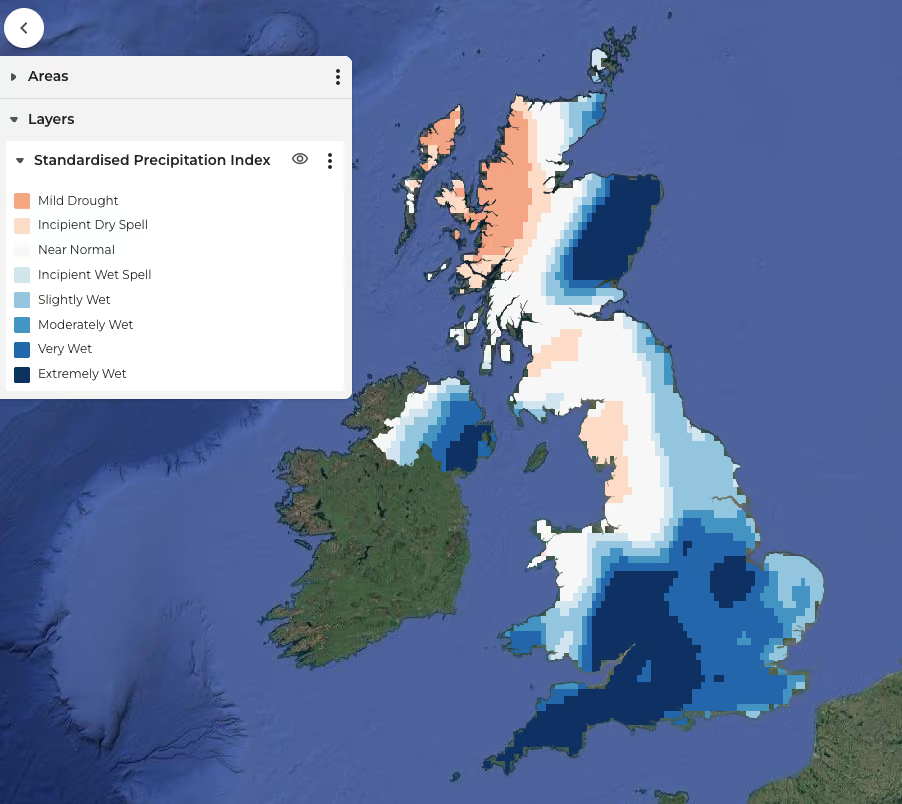
For leadership teams, the implications of a fundamentally altered hydrological cycle are appearing across diverse sectors.
Agri-Food and Beverage: The weather whiplash has moved past a series of bad harvests into a structural supply crisis. UK arable farmers sustained an estimated £600 million in lost revenue from the 2024 harvest alone, following a 21% drop in wheat yields due to extreme wet weather. When 50 days of rain prevent planting and drown winter crops, just-in-time sourcing models collapse.
Transport and logistics: The impact on transport is often misdiagnosed as mere delay. The reality is bridge scour, the erosion of sediment around bridge foundations caused by hyper-saturated ground and high-velocity river flow. This structural degradation necessitates speed restrictions and route closures that are not currently priced into logistics contracts, creating a silent drain on operational margins.
Real Estate and Insurance: We are approaching a tipping point in asset valuation. In 2025, weather-related property insurance payouts hit a record £6.1 billion. As risk models adjust, we are seeing the emergence of stranded assets, properties in high-risk postcodes that are becoming uninsurable and, consequently, unmortgageable.
While many organisations are currently focused on meeting new disclosure requirements, the 50-day deluge in Cornwall highlights a deeper necessity. For the C-suite, the transition involves moving beyond compliance-based reporting toward using nature-driven insights as a primary intelligence layer for a fundamental pivot in operational strategy.
Integration of spatial nature data allows procurement teams to move beyond "just-in-time" efficiency toward "just-in-case" resilience. By surfacing high-risk water-insolvent zones, businesses can prioritise investments in regenerative agriculture, such as cover cropping and improved soil structure, to restore the land’s natural ability to manage water. This isn't just green farming; it’s rebuilding the physical natural savings accounts that secure future yields.
For transport and real estate, high-resolution nature insights pinpoint exactly where bridge scour, or surface flooding, threatens an asset's valuation. This intelligence allows leaders to move from reactive repairs to proactive adaptation, such as implementing Nature-Based Solutions like the restoration of upstream wetlands and floodplains, to protect downstream logistics hubs and warehouses.
CFOs must begin pricing the cost of inaction. As the insurance gap widens, the businesses that thrive will be those that use nature data to prove their assets and supply chains are actively adapted to a more volatile hydrological baseline.
To navigate this era of water bankruptcy, the focus must shift from reacting to extreme weather events to leading a systemic adaptation. By surfacing these insights now, businesses can move from vulnerability to a position of commercial strength — not just surviving the storm, but building the capacity to thrive in a fundamentally altered world.