
With nature underpinning economic stability, understanding it is now a leadership imperative.
Lloyds and Earth Blox quantify nature risk for corporates in new report, The Missing Line Item
Read the report
.avif)
With nature underpinning economic stability, understanding it is now a leadership imperative.
At the 2026 World Economic Forum (WEF) in Davos, Andrew Forrest of Fortescue issued a challenge that now resonates in boardrooms globally: "We risk being those business and political leaders who knew of the planet's limits, and elected to cross them anyway". A stark warning to any leaders who are seeking to submerge the projected crossing of our planetary boundaries with misinformation and myopic economic policies.
The WEF 2026 Global Risks Report, released just before global leaders gathered in the Swiss city, highlights a dangerous temporal mismatch and emphasises the warning from Dr. Forrest. The short-term risk profile is dominated by concerns regarding geoeconomic confrontation, armed conflicts, and misinformation, with biodiversity loss and critical change to earth systems experiencing some of the biggest falls over the two-year risk horizon. However, flip to the long-term outlook and the environment dominates the projected risk profile in 2036 (as it has done for a number of years). Five of the top 10 risks are environmental, with extreme weather and biodiversity loss occupying the top two spots. This implies that leaders who focus solely on immediate geopolitical noise (see - the US confirming their official exit from the Paris agreement) are borrowing from a future that is increasingly defined by declining ecological outlooks.
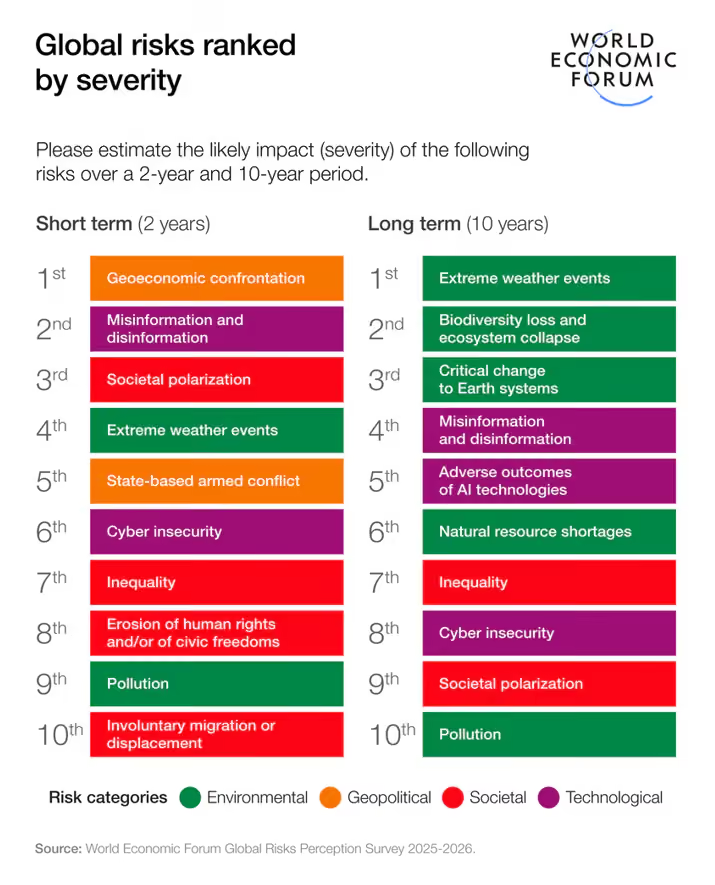
However, analysing these risks in silos ignores their interconnectedness. The UK government have recognised this in their “Nature security assessment on global biodiversity loss, ecosystem collapse and national security” which concluded that nature is a core pillar of national strategic infrastructure. It warned that the collapse of "strategic ecosystems" like the Himalayan glaciers, Congo rainforests and Cerrado tropical savanna, which underpin UK food security and regional stability, could disrupt food supplies and trigger regional instability. The Times reported that an unabridged version of the report goes further and links nature loss to future mass migration events and the threat of nuclear war.
This is no longer a localised concern. NATO’s latest security assessments identify environmental degradation as a "threat multiplier" that exacerbates resource competition. Similarly, Australia’s National Climate Risk Assessment highlights how the decline of critical ecosystems, such as eucalypt woodlands and the Great Barrier Reef, poses systemic risks to the national economy. Managing nature is now synonymous with managing the foundational stability of the global economy. The private sector will play a key role in the required transformation given its dependency on healthy ecosystems to provide critical services such as water supply, healthy soils and genetic diversity.
Despite entering a somewhat messy phase for climate policy, the underlying economics of the energy transition are already reaching a point of no return. The energy transition provides the blueprint for the broader nature space. Sustainability has shifted from a cost centre to a driver of ROI and competitive advantage. China identified this economic switch early: its "New Three" industries (solar, electric vehicles, and batteries) contributed a record 10% to its GDP in 2024, growing three times faster than the overall economy. This is happening in the private sector as well, with Fortescue registering the fastest growth rate in its region, supercharged by the scale-up and deployment of green technology. The emergence of a nature-positive economy is inextricably linked and should be a logical and necessary extension of this transition.
Businesses that recognise this early will unlock long-term value and build resilience against environmental shocks. Systems like agriculture (regenerative) and materials (circularity) are the next frontiers. From circular construction materials to nature-positive farming that restores soil health, the winners of 2026 will be those who ride this economic wave rather than being submerged by it. This transition will require environmental intelligence to support interventions being taken in the right places.
For years, "lack of data" was the default excuse for inaction. In 2026, that excuse is obsolete. With the nature technology space exploding and the future development of the Nature Measurement Protocol (NMP), we will finally have a standardised language to put nature on the balance sheet.
With well over 10,000 active satellites now orbiting the Earth (>1,000 of which are dedicated to earth sciences), we are in an era of data proliferation. The executive challenge has inverted: it is no longer about acquiring data, but about deriving Nature Intelligence - the wisdom to filter the deluge of signals into actionable insight.
This is where Earth Blox provides the critical bridge. By turning petabytes of satellite data into decision-ready metrics, we enable businesses to move beyond reporting into strategic delivery. For example, Lloyds Banking Group utilised Earth Blox to map 5.1 million hectares of UK farmland (30% of the country’s total area) in minutes. This portfolio-wide visibility allowed them to identify where environmental pressures like drought translate into credit risk and where resilience can be grown through targeted finance. This foresight is driving the adoption of "nature value at risk" (NVaR), a framework pioneered by central banks to quantify how specific ecological shocks translate into direct financial loss. By calculating NVaR, we support organisations in pinpointing exactly where their economic output is most vulnerable to ecosystem degradation, transforming environmental signals into precise boardroom metrics.
In 2026, the mandate for business and world leaders is clear: nature risk is no longer peripheral; it is a material driver of prosperity and security. The organisations that thrive will be those that use wisdom to lead within planetary boundaries, ensuring that thriving ecosystems remain our most valuable economic assets.


.avif)