Arcadis and Earth Blox launch NEST, nature intelligence for faster, better-evidenced business decisions
NEST combines nature and engineering expertise with geospatial technology, turning an organisation’s questions about nature into evidence it can act on, quickly and across entire portfolios.
Global design and consultancy organisation Arcadis and nature analytics provider Earth Blox will showcase NEST (Nature Evaluation & Strategy Tool) at the UN Biodiversity Conference (CBD COP17) in Yerevan, Armenia, this week.
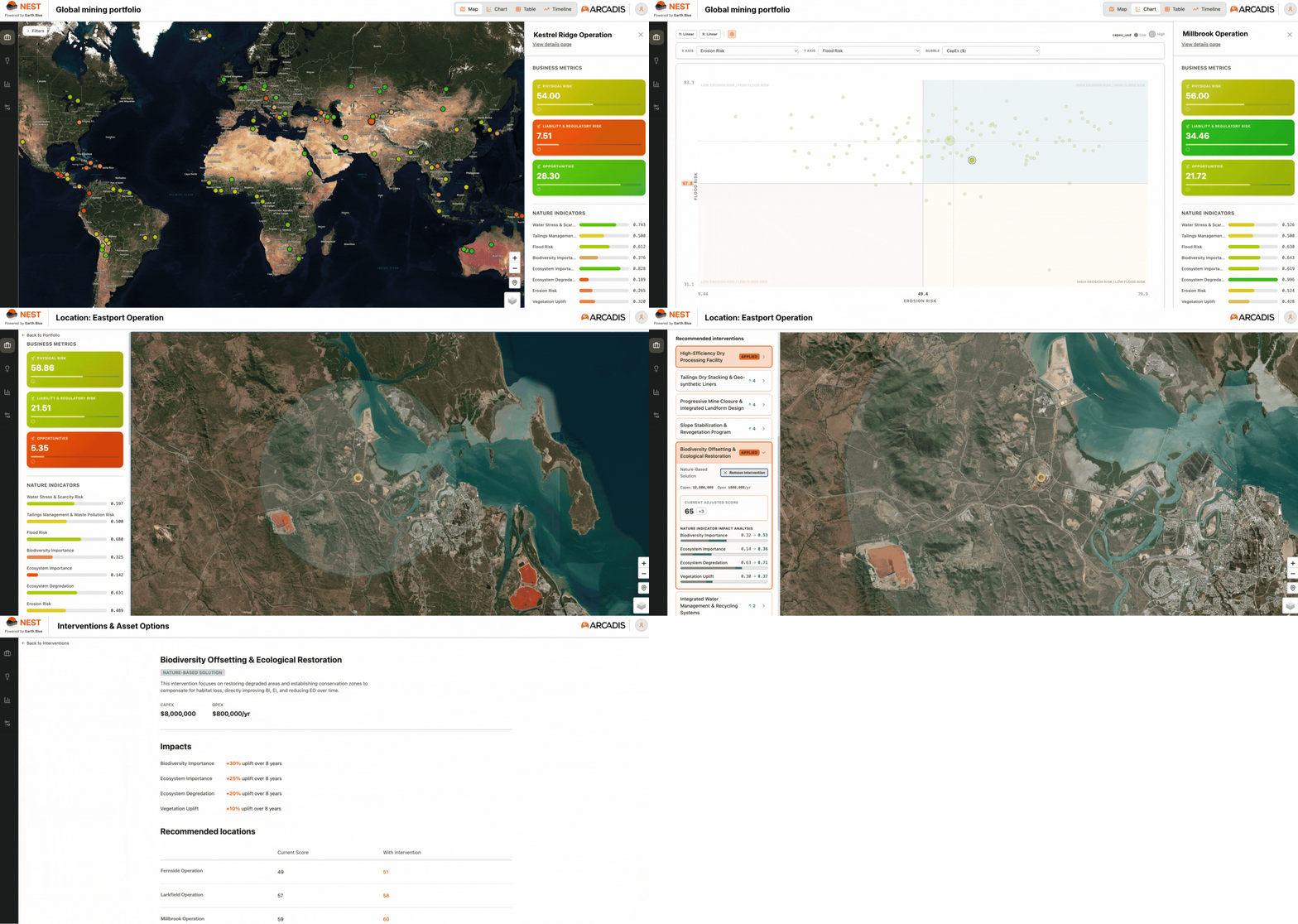
NEST starts with the decision a business needs to make, such as where to build or how to reach a nature-positive target. It scores sites and portfolios for the nature-related risks and opportunities that bear on that decision, then compares the interventions that would change the outcome. Results are expressed in the business terms clients work in: feasibility, cost and risk.
Designed for any sector, NEST gives Arcadis specialists access to over 300 geospatial datasets in the Earth Blox platform, covering biodiversity, water, vegetation, climate, soil and social context, with satellite imagery that shows how site conditions change over time.
“Our clients’ questions about nature have become very practical: which sites carry the most risk, where can investing in nature lower lifecycle costs or ease permitting, and what to do first. NEST answers them with site-level risk and opportunity scores across an entire portfolio, and compares scenarios with different sets of interventions. It does this in hours, transparently and on one consistent basis,” said Johan Lammerant, Global Nature & Biodiversity Technical Director at Arcadis.
NEST is available today for two use cases, both configured by Arcadis specialists to each client’s question and sector:
1. Heatmapping scores every site in a portfolio on physical risk, permitting and liability risk, and the potential for nature-positive action. It draws on indicators such as flood, erosion, drought, wildfire, water and biodiversity, so ten assets, or ten thousand, can be screened on the same evidence. It also identifies the locations best suited to restoring nature, through actions such as regenerative agriculture or nature-based solutions.
2. Intervention optioneering then draws on Arcadis’ catalogue of nature-based solutions, engineering measures and management practices, each with indicative capital and operating costs and an estimated effect on those indicators. It ranks the measures that most cost-effectively reduce risk or deliver nature-positive outcomes at each site. Client information on interventions and costs can be included too.
Transparent, configurable, built to scale
Every score in NEST traces back to a visible workflow in Earth Blox, and Arcadis runs its own methodology on top: indicators, buffer distances, business-metric formulas and the intervention catalogue are all configurable, and can be aligned to the requirements of the Taskforce on Nature-related Financial Disclosures (TNFD), the Nature Positive Initiative (NPI), or other frameworks. Underneath sits a curated catalogue of global datasets at resolutions down to 1 metre, on a platform that already runs portfolio-scale analysis for banks and corporates across agriculture, forestry, energy, extractives and infrastructure.
From nature data to decisions
Nature has moved beyond disclosure into business and financial decisions, and capital is starting to follow. The TNFD reported in its 2026 Status Report that 56% of investors are already exploring or deploying capital into nature-related opportunities, and 74% expect financing for those opportunities to increase two- to fivefold over the next five years.
“Lenders, investors and permitting authorities now expect the evidence behind a nature decision to be consistent, comparable and auditable. With NEST, Arcadis and its clients can trace every score back to the datasets and calculations behind it. Pairing that transparency with the engineers who deliver the work is how nature analysis turns into action on the ground,” said Mike Mason, Chief Commercial Officer of Earth Blox.
Engineering consultants sit at the centre of this work. The question is no longer only what a company’s dependencies and impacts are, but where nature can protect an asset from physical hazards, where a nature-based solution offers better lifecycle value than engineered alternatives, which sites can secure permits, and where restoration could unlock finance. These are engineering and investment questions as much as ecological ones, which places engineering consultants at the centre of this work as their specialists already turn assessments into designs, costs, permits and delivery programmes.
Until now, the constraint has been capacity, because every site is different and a portfolio-wide screen can tie up a specialist team for months. NEST removes that constraint. Clients get a consistent evidence base across every site, and a clear line from each risk to the interventions that address it.
Arcadis and Earth Blox are inviting organisations to see how NEST applies to their own sites and portfolios.